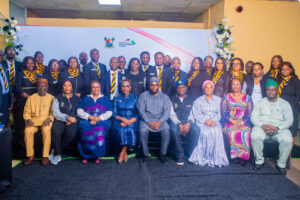
PSAP Ignites Next-Gen Public Service Leadership in Lagos

Background question: Can we get to meet you. Tell us a bit of your leadership journey.
My name is Oluwatoyin Atanda. My leadership journey has been driven by a simple belief: leadership is about creating opportunities for others to grow and succeed. I have been privileged to serve in both the private and public sectors, and today, as Senior Special Assistant to Mr. Governor on Establishments and Training, my focus is on building the capacity of our public servants to deliver better outcomes for Lagosians. That journey has seen us pioneer initiatives such as the Public-Private Exchange Programme, the Public Service Accelerator Programme, the Lagos State Government Learning Management System, and several other human capital development initiatives.
Beyond government, I have had the honour of serving as the 2025 National President of Junior Chamber International (JCI) Nigeria, becoming the eighth female to lead the organisation nationally. It was a rewarding opportunity to work with thousands of young leaders across the country, championing community development, leadership, and sustainable impact. I was humbled to be recognised as the Most Outstanding National President among more than 100 JCI National Presidents worldwide at the 2025 JCI World Congress in Tunisia. This is an achievement I dedicated to the incredible members and leadership team of JCI Nigeria.
In addition to these roles, I have been actively involved in various leadership and professional development initiatives that have strengthened my perspective on governance and organisational growth. My experience spans working with cross-functional teams, mentoring emerging leaders, and contributing to policy and strategy discussions that drive institutional effectiveness. I have also participated in international leadership forums and capacity-building programmes, which have broadened my understanding of global best practices and reinforced my commitment to continuous learning and innovation in public service.
Across every role I have held, one thing has remained constant: a passion for developing people. Whether in government or through JCI, my goal has always been to empower others, build stronger institutions, and inspire leadership that creates lasting impact. That is the philosophy that continues to shape my work and the vision behind PSAP.
As the driver of the Public Service Accelerator Programme (PSAP), how do you envision this initiative fundamentally altering the DNA of the Lagos State Civil Service over the next five years?
I believe the future of the Public Service will not be defined by processes alone, but by the quality of its people. Through PSAP, we are intentionally building a pipeline of Civil Servants who think differently, collaborate across MDAs, embrace innovation, and are equipped to solve complex governance challenges.
Over the next five years, my vision is for PSAP to create a strong network of reform champions embedded across the Lagos State Public Service. As each cohort grows and passes on its learning to others, we will gradually build a culture where leadership, continuous learning, accountability, and innovation become part of the DNA of the Civil Service. Ultimately, success for us is when these values become the norm rather than the exception.
Many leadership programs exist; what makes the PSAP unique in its approach to tackling the specific governance challenges faced by Lagos State?
What makes PSAP different is that it is not just a leadership training programme; it is a leadership transformation programme built specifically for the realities of the Lagos State Public Service. Every session, case study, mentoring engagement, and group project is designed around actual governance challenges facing our State. Asides the classroom, participants are expected to collaborate across MDAs and develop practical solutions to public sector problems. They are also required to transfer their knowledge through our Pass-It-On initiative, ensuring that the impact of the programme extends beyond the immediate cohort. We are also building a lifelong network of reform-minded officers through the PSAP Alumni Association that was just recently launched. In essence, PSAP is not just developing better individuals; it is building a stronger, more collaborative, and future-ready Public Service.
The PSAP is deeply rooted in the T.H.E.M.E.S+ agenda. Can you share a success story from the first cohort where a participant’s project directly translated into a measurable improvement in public service delivery?
One of the key strengths of PSAP is that participants work on real public sector challenges, not hypothetical exercises. While many of the cohort’s projects are still at different stages of adoption, the programme has already produced tangible outcomes. For example, several participants have led the Pass-It-On initiative within their MDAs, cascading the knowledge and skills acquired through PSAP to hundreds of fellow officers, thereby creating a multiplier effect that reaches far more than the original 100 Accelerators.
In addition, the top group projects, such as the proposed Digital Performance Management System and the LAG ID (Unified Digital Identity & HR Management System), have been recommended for government consideration because of their potential to improve accountability, workforce planning, and service delivery. For us, success is not only measured by projects implemented immediately, but by building a pipeline of practical ideas and reform-minded leaders who are equipped to drive the THEMES+ agenda across the Lagos State Public Service.
Asides group projects, individual fellows are already driving impactful reforms across their respective MDAs. For instance, Agunbiade Funmilayo Rebecca of the Primary Health Care Board transitioned from a clinical practitioner to a strategic health reformer by initiating proposals for the Shared Ambulance Services (SAS) and the In-Facility School Health Program (IF-SHP), leading to reduced emergency response times, lower maternal and neonatal mortality rates, and expanded health screening for school-aged children. At the Lagos State Pension Commission, Akinwolemiwa Olubunmi Bolanle strengthened pension administration through the Annual Retirement Readiness Seminar, improving benefit processing efficiency and enhancing stakeholder awareness. Arebi Ismail Tubosun of the Office of Sustainable Development Goals improved procurement efficiency by developing a shared digital workflow system, significantly reducing delays and enhancing interdepartmental coordination. Similarly, Olaniyan Zainab Olamide of the Lagos State Health Service Commission has promoted multidisciplinary collaboration and preventive health education through seminars she started, resulting in improved patient outcomes and stronger clinical coordination. At the Lagos State Debt Management Office, Mustapha Bolarinwa Abdullahi led the development of a comprehensive Debt Management Strategy and established a knowledge repository, institutionalizing prudent borrowing practices and strengthening risk management. These examples demonstrate how PSAP fellows are translating learning into measurable improvements in governance and service delivery across Lagos State.
With applications open for the second cohort, what are the three non-negotiable qualities you and your team look for in a candidate to ensure they are the right “accelerator” for our future?
First, we look for leadership potential. We are not necessarily looking for the most senior officers, but for individuals who show initiative, influence others positively, and are willing to take responsibility for driving change.
Second is a growth mindset. PSAP is an intensive learning journey, so we want candidates who are curious, adaptable, and open to new ideas and ways of working.
Finally, we look for a genuine commitment to public service and a clear alignment with and embodiment of Mr. Governor’s THEMES+ agenda, demonstrating a strong understanding of its priorities and a passion for translating them into tangible outcomes. The best Accelerators are those who see challenges as opportunities to improve service delivery and are willing to take what they learn back to their MDAs. At the end of the day, we’re not just selecting participants; we’re identifying future leaders who will help shape the next chapter of the Lagos State Public Service.
The programme places great emphasis on the “Pass-It-On” model. Why is this mentorship-downward approach critical to the sustainability of the administrative reforms you are pushing for?
The Pass-It-On model is central to the sustainability of PSAP because lasting reform cannot depend on just 100 participants. For change to become institutional, knowledge must spread across the wider Public Service.
That is why every Accelerator is expected to return to their MDA and share what they have learned with colleagues. This creates a multiplier effect, builds internal capacity, and fosters a culture of continuous learning. During the first cohort, this approach enabled us to reach more than 500 Civil Servants across over 20 MDAs, and we are intentional about surpassing this impact in the second cohort. More importantly, it ensures that the ideas, leadership practices, and innovations introduced through PSAP become embedded within the system rather than remaining with a select few. That’s how real and lasting public service transformation happens.
Why was the Grade Level 12–14 bracket specifically targeted for this accelerator, and how does equipping this tier help bridge the gap between policy formulation and ground-level execution?
Grade Levels 12 to 14 represent a critical segment of the Public Service. These officers are experienced enough to manage teams, coordinate programmes, and influence implementation, while also having many productive years ahead of them to grow into senior leadership positions. By investing in this cadre, we are strengthening the bridge between policy and execution. These are the officers who translate government decisions into action on a daily basis. Equipping them with leadership, innovation, and problem-solving skills ensures that policies are not only well understood but are also implemented more effectively, ultimately leading to better outcomes for the people of Lagos State.
You have successfully championed programmes like the Public-Private Exchange. How does the PSAP curriculum integrate private-sector agility and efficiency into the traditional public service structure?
One of the key philosophies behind PSAP is that the Public Service can learn a great deal from the private sector without compromising its core values. That’s why we’ve intentionally integrated sessions on strategic leadership, innovation, design thinking, change management, digital transformation, and performance management, delivered by both accomplished public servants and respected private sector leaders. These sessions are designed not just to transfer knowledge, but to reshape mindsets and encourage a more proactive, solution-oriented approach to governance.
We also expose participants to practical case studies and real-world problem-solving, encouraging them to think more collaboratively, focus on results, and embrace continuous improvement. By engaging with real challenges and learning from proven private-sector practices, participants begin to appreciate the importance of agility, accountability, and customer-centric service delivery within the public sector context.
Ultimately, the goal is to cultivate a Public Service that is not only efficient and innovative but also responsive to the evolving needs of Lagosians. By blending the strengths of both sectors, PSAP is helping to build a workforce that can deliver faster, smarter, and more impactful outcomes for the people we serve.
Change in a large institution like the Lagos State Civil Service often meets resistance. How does the PSAP prepare its participants to be “change agents” who can navigate institutional inertia?
We recognize that meaningful reform is as much about people as it is about policies, processes, or structures. That is why PSAP goes above teaching technical skills to deliberately building the leadership capacity, communication proficiency, and influence required to drive sustainable change within large and often complex institutions. By focusing on both mindset and capability, the programme prepares participants to navigate resistance, inspire confidence, and lead transformation efforts with clarity and purpose.
Participants are equipped with practical skills in change management, stakeholder engagement, systems thinking, and influencing without formal authority, all of which are essential in a public service environment where collaboration and consensus are key. They also work on real public sector challenges, applying these concepts in practical settings, and learn directly from leaders who have successfully led major reforms. This combination of theory and hands-on experience ensures that participants are not only knowledgeable but also confident in applying what they have learned.
For instance, Accelerators from the first cohort were personally mentored by ten Permanent Secretaries across critical ministries, creating a structured platform for guidance and professional growth. This deliberate pairing ensures a rich exchange of institutional knowledge, allowing participants to benefit from the experience, wisdom, and strategic insights of senior leaders while also bringing fresh perspectives and innovative ideas to longstanding challenges within the system.
And because participants are drawn from different ministries, departments, and agencies, they begin to build strong cross-ministerial networks that extend outside the duration of the programme. These relationships make it easier to drive change more quickly, foster collaboration across MDAs, and encourage the sharing of best practices. Ultimately, this helps to break down silos, strengthen coordination, and enable more cohesive and effective governance across Lagos State.
Beyond the classroom experience, how does your office track the long-term career trajectory and institutional impact of PSAP alumni once they return to their respective MDAs?
For us, graduation is not the end of the journey, it’s the beginning. We remain engaged with our Accelerators through the newly established PSAP Alumni Association, the Pass-It-On initiative, structured alumni engagements, and continuous interaction with their respective MDAs. A key part of this approach is the deliberate building of a strong, interconnected network of alumni who can collaborate, share insights, and support one another in driving reforms across the Public Service. This network serves as both a support system and a platform for sustained influence, ensuring that the values and competencies developed during the programme continue to translate into tangible outcomes.
We also track the implementation of reform ideas, leadership initiatives, and innovations championed by alumni within their workplaces through regular surveys, feedback mechanisms, and periodic impact assessments. In addition, participants continue to benefit from mentoring opportunities and are encouraged to support future cohorts, reinforcing a cycle of knowledge transfer and institutional strengthening.
Furthermore, we have just finalised a strategic partnership with the National Institute for Policy and Strategic Studies (NIPSS), Kuru, to deliver a specialised policy course for the first cohort. This collaboration is designed to deepen their policy formulation and strategic thinking capabilities, further enhancing their ability to contribute meaningfully at higher levels of governance.
Through these combined efforts and others, we are able to track not just individual career progression, but also the broader institutional impact of PSAP across the Lagos State Public Service, ensuring that the programme delivers sustained value over time.
For those civil servants currently hesitating to submit their applications, what is your message to them regarding their role in the “Greater Lagos” vision and the urgency of self-development?
My message is simple, don’t wait for the future, prepare for it! The Lagos State Public Service is evolving, and the demands of leadership and service delivery are changing with it. PSAP is an opportunity to invest in yourself, expand your capacity, and become part of the next generation of leaders shaping the future of our State. Every Civil Servant has a role to play in delivering the Greater Lagos vision. If you are passionate about making a difference, willing to learn, and ready to lead, I encourage you to apply. Your growth is not just a personal achievement; it is an investment in a stronger, more innovative, and more effective Public Service for all Lagosians.

You may also like

CLOSING CEREMONY – COHORT 1

PASS-IT-ON (KNOWLEDGE SHARING)